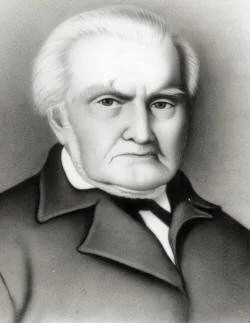
Nathaniel Ames Chapter
The Nathaniel Ames Chapter was chartered on the second day of December, 1955. Its charter members were Grant M. Hyde (President), Bentley Courtenay (Vice President), Conrad D. Kohler (Secretary-Treasurer), Scotten K. Hale, Walter J. Kohler III, Robert Martin, Howard I. Miller, Voris A. Miller, Walter W. Miller and James P. Reed.
The Ames Chapter meets the third Thursday in January, March, May, September, and November at 6:00 p.m. Meeting locations vary. At this time it has 44 members. Please check the Calendar Page for meeting information (under construction). Members of the Ames Chapter participate in the State Society’s Color Guard and the Society’s Board of Directors.
Chapter Officers
President: William Austin
Vice President: OPEN
Secretary: William A. Muether
Treasurer: William A. Muether
Genealogist: Robert J. Stone
Our Namesake
George Washington is well known to everyone. As a young man he was a surveyor and messenger in the wilderness. Later, he was a soldier and commander of the army. As President, he became our most beloved citizen. When he was a young man, Washington served with General Braddock, who was defeated by Wisconsin Indians under the command of Charles Langlade. Here is a story of George Washington and another Wisconsin citizen, Nathaniel Ames. Ames was a soldier, sailor, preacher and patriot. He lived the last years of his life in Wisconsin. Before he died, he told of his life.
Nathaniel Ames was born in Rhode Island in 1761. At six years of age he moved to Connecticut and was raised by his grandfather after his father was killed in the French war. He was a teenager when the Revolutionary War began, and at age 17 he served for one month as a guard on a ship. He also helped build Fort Griswold, which was near his home in Groton, Connecticut.
In 1779, Nathaniel joined the army. His enlistment was up in less than a year, then he joined General Huntington’s brigade. During the winter of 1779–80, Nathaniel was stationed with the army near Morristown, New Jersey. It was a time of terrible suffering. The weather was cold, soldiers lived in small log huts, and they had little warm clothing. Many had only straw for a bed, and each man had a single blanket for a covering. Some didn’t have shoes. The snow was deep and fell early in the autumn, lasting late into spring.
"We have," said George Washington, "had the patience of the army put to a test. Sometimes the men have been five or six days without bread. At other times as many days without meat. Once or twice, two or three days without either."
"At one time the soldiers ate every kind of horse food but hay. Buckwheat, wheat, rye, and Indian corn were ground into flour for bread."
"Washington," said Mr. Ames, "hearing of our suffering, came to the barracks. He looked in and spoke words of sympathy and encouragement. We told him we hoped to live until spring. We were eager to fight our country’s battles."
In the fall of 1780, the young soldier returned home again. He joined the crew of the ship La Fayette (it had sixteen guns). The ship sailed to Newport, Rhode Island, when a French fleet entered the harbor at the same time. These ships carried soldiers and had come to help the Americans. Nathaniel remembered both seeing and hearing these men. They wore wooden shoes, and when they marched they made a loud tramping sound.
British vessels dropped anchor outside the harbor. The La Fayette could not leave, then George Washington visited the town and welcomed the Frenchmen. Nathaniel was proud to see Washington again. When the La Fayette was finally able to leave port, Nathaniel sailed on several of her voyages. On one trip the ship was captured and the crew were taken to Bermuda. They spent three months on the island.
When the Revolutionary War ended in 1783, Nathaniel joined the crew of another ship. He traveled all over the world, but he became sick with yellow fever and nearly died. Returning home, Nathaniel went to school for a time. He married Sarah Hall and became a farmer. Then, at 30, he became a Methodist preacher. The family moved to Steuben, New York, where Nathaniel preached for forty-five years. Then, at the age of 75, he moved to Wisconsin with his wife and three of his children and bought a farm near Oregon in Dane County. Mrs. Ames died at 89.
In 1859, a friend asked, "Do you remember Washington?" "Yes," replied Nathaniel, "and old Steuben, too." He paused and thought back through the years. He remembered the excitement and suffering of the war. Big tears rolled down his aged cheeks. Then he added, "You must excuse these tears. For I can never think of these good men without causing my heart to be stirred within me."
Nathaniel Ames, patriot, died in 1863. Years later, special ceremonies were held at his grave. In 1924 the Evansville Nathaniel Ames Masonic Memorial Masonic Lodge erected a monument to this patriot in the Prairie Mound Cemetery at Oregon. That year, the Daughters of the American Revolution also put a marker there, which two of Nathaniel’s great-great grandsons unveiled. An official Wisconsin Historical Marker was placed at the Prairie Mound Cemetery honoring Patriot Ames on April 20, 2002.
WISSAR is most thankful to Shirley Anderson Erfurth who furnished the portrait of Nathaniel Ames. She is a direct descendent of Nathaniel Ames through her mother Marion Ellis Anderson. Marian's mother was Sadie Ames Ellis. Sadie's father was Francis Marion Ames. Francis was the son of John Norton Ames. John Norton's father was David Ames who was Nathaniel's son.
Source: The State Historical Society of Wisconsin, The Revolutionary Years, 1750-1815.
Capt. Hendrick Aupaumut Chapter
Our Chapter meets quarterly each year. We meet at various locations within the bounds of our regional coverage area. The specific dates, times, and locations are yet to be announced. Spouses, other family members, and guests are always welcome.
We also have a Color Guard formation that supports National, State, and local level events. We invite and encourage you to become a member of our Color Guard.
Our Chapter also supports youth programs to include, but not limited to, Scouts, Elementary School Poster Contest, High School Essay Contest, and more. This is a great way to give back to the community.
Chapter Officers
President: David Grover
Vice President: Daniel R Fay
Secretary: Bruce Deadman
Treasurer: Gary McCully
Genealogist:
Sergeant at Arms: Jimmy Safford
Our Namesake
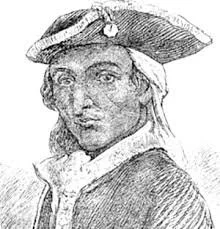
Hendrick Aupaumut (ca. 1775-1829) was born about 1757 in Stockbridge, Massachusetts. He was a resident in Stockbridge at the time of his initial enlistment in the Revolutionary Forces, June 23, 1775. Aupaumut served as a private in Captain William Goodrich's Drawn portrait of Capt. Hendrick Aupaumut Company of Indians in Colonel John Patterson's Regiment, according to a muster roll dated August 1, 1775. Colonel Patterson's Regiment was stationed with the army near Boston and may have been present at the battle of Bunker Hill, although Colonel Patterson's Regiment was under orders from general Artemas Ward, stationed with Colonel Thomas Gardner's Regiment at the redoubt on Prospect Hill. The redoubt was one of the major fortifications protecting the Cambridge Road.
Aupaumut is recorded as having received the enlistment bounty of "an overcoat or equivalent money" on February 27, 1776, and also that he was present at Van Schaik's Island on September 5, 1777, when he received thirty flints for use of the Indians. By 1778 Aupaumut had become a lieutenant in Captain Ninham's Company of Indians and the same year, in a battle in which Washington's Army engaged the British at Three Plains, Aupaumut received a battlefield promotion to Captain. Captain Aupaumut had been present at Saratoga, as well as other actions as a scout for American forces. He re-enlisted regularly and remained in the service through 1782. After the war, in 1791, he was presented a sword by General Washington. Captain Aupaumut re-enlisted with the army during the war of 1812 and served under General William Henry Harrison.
In 1821 Hendrick Aupaumut moved with his people to lands they had purchased from the Menominee Indians near Green Bay, with the idea of establishing a new colony. Captain Aupaumut died in September, 1829, and is buried on the Frank Thelen farm in the old Stockbridge Indian Cemetery near Kaukauna, Wisconsin.
(For some additional information about Capt. Aupaumut and American Indians during the Revolutionary War period, visit Stockbridge-Munsee History)
Morgan-Kosciuszko Chapter
CHAPTER OFFICERS
President: Donald Skarda
Vice President: Robert Wylie
Secretary: Matt Sonnenburg
Treasurer: Jim Rogge
Color Guard: TBA
Chaplain: Benjamin Meador
Several years ago the James Morgan Chapter and the Thaddeus Kosciuszko Chapter, both active in Milwaukee and surrounding communities, merged to become the Morgan-Kosciuszko Chapter, becoming one of the larger chapters in the Wisconsin Society, Sons of the American Revolution.
Our Namesake
James Morgan and Thaddeus Kosciuszko, Patriots
James Morgan was born April 5, 1748, in Frederick County, Virginia. While a resident of Monongalia County, Virginia, Morgan, age 30, enlisted in August of 1778 for three months in Captain James Brenton's Company of Colonel John Evan's Virginia Regiment. He was in General Lachlan McIntosh's campaign into the Ohio country and assisted in erecting Fort McIntosh and Fort Laurens.
Morgan re-enlisted at Morgantown, Virginia, in 1779 for a three-month term with Captain Samuel Mason's Company of Colonel Daniel Brodhead's Pennsylvania Regiment and participated in the expedition against the Indian towns on the Allegany. Morgan was enlisted as a scout and spy against the Indians. This final tour was with Colonel Evans.
James Morgan resided in Morgantown, Virginia, until 1820 when he moved to Vermillion County, Illinois. He subsequently moved to Wauwatosa in the late 1830's. There he died at age 92 on March 3, 1840, and was buried in the Wauwatosa Cemetery.
Thaddeus Kosciuszko was born in Poland on February 4, 1746, the son of Ludwik and Tekla Kosciuszko. He attended school in Lubieszow and then Cadet Academy in Warsaw before continuing his engineering studies in Paris, France. By the time Thaddeus arrived in America from Poland in 1776, he was a skilled engineer who came to offer his services to the American colonies in their struggle for independence. On October 18, 1776, Kosciuszko was commissioned as Colonel of Engineers by the Continental Congress and began his outstanding service of fortifying battle sites, many of which became turning points in America's fight for independence against the British.
There is a statue of of this Patriot in Kosciuszko Park, 2201 S. 7th Street, Milwaukee, and the Kosciuszko Community Center is located near the park.
Elisha Raymond Chapter
Welcome to the Elisha Raymond Chapter!
Our chapter will meet five times in 2026 on the following dates: January 10, March 14, May 16, September 12, and November 14.
All chapter meetings are held at the Castlewood Restaurant, 2811 Wisconsin Street, Sturtevant, Wisconsin. Meetings begin at noon, with lunch available to order. Spouses, other family members, and guests are always welcome.
Our chapter assists in placing State Historical Markers at cemeteries where Revolutionary War veterans are buried. Other activities include appearances at community events and programs, as well as sharing the story of the sacrifice and service of our Revolutionary War ancestors.
We look forward to seeing you soon. Please feel free to contact one of our officers for further information on the SAR and the Elisha Raymond Chapter. Membership inquiries may be directed to the Chapter Registrar or Chapter President.
Chapter Officers
President: Bruce Laine
Vice President: Joseph Arthur
Secretary: Brian D. McManus
Treasurer: Brian D. McManus
Registrar: Bruce Laine
Chaplain: Jeffory E. Burdick
Eagle Scout: Jeffory E. Burdick
Our Namesake
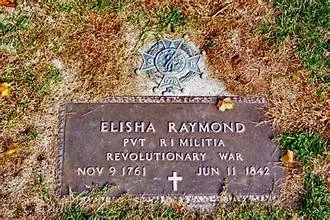
Elisha Raymond, son of William and Amey Raymond, was born at Gloucester, Rhode Island, November 9, 1761. In February 1776, at the age of 14, Elisha joined the state militia. He served a one month enlistment each for John Warner, Jeremy Ballard, Joshua Matterson, his brother Thomas, and Daniel Barnes, until about February 1777. In March or April of that year he served as a substitute for his father, William, in the militia of Providence, Rhode Island.
Beginning on July 1, 1777, he served one month as a substitute for John Inman of Gloucester and then enlisted for three more months. After serving this enlistment, he returned to Gloucester. In 1781, he joined the Light Infantry. After the capture of Cornwallis, and after serving about one year of a 15-month enlistment, he transferred to the Continental Army. He was discharged at Saratoga, New York, in December 1782.
Elisha married Abigail Inman in Gloucester on April 25, 1781. They had 12 children: Alfred, Elisha Jr., Truman, Direxa, Anne, Reuben, Jason, Adin, Melita, Abigail, Matilda and Zelick.
Shortly after peace was declared between Great Britain and the Colonies, Elisha, his wife and first child, moved to Stamford, Bennington County, Vermont. There they raised cattle, sheep and swine. Elisha also served as a Selectman of Stamford and was among those appointed a highway surveyor.
Elisha apparently wanted to visit his sons and grandsons, who had gone west to the Territory of Wisconsin, and died here before returning to his wife, who was still in Stamford, Vermont. He died on June 11, 1842, at age 81 and was buried on his son's farm in Raymond Township, Racine County. Later, his remains were transferred to Racine’s Mound Cemetery and buried in Lot 85, Block 19, Grave 5.
The Origins of the Elisha Raymond Chapter
Early in 1967, members of the Wisconsin Society of the Sons of the American Revolution began contacting prospective members for a chapter to be formed in Racine and the immediate vicinity. Mr. Miles W.D. Allen, Mr. Willis E. Gifford, with the assistance of DAR members, especially Mrs. Lester J. LeMack, contacted prospective members. Dr. Ralph C. Pierce and Mr. Stanley R. Belden assisted Mr. Gifford in completing the applications.
The ceremonial recognition of the Racine and Kenosha Chapters took place on May 17, 1967, at a dinner at the Valley Supper Club. Racine had 16 charter members. Mr. Belden’s Revolutionary War ancestor, Elisha Raymond, was chosen as the Racine Chapter’s namesake. The officers for the first year were President Stanley R. Belden, Secretary John H. Batten, and Treasurer Charles F. Rogers.
The following officers were elected September 17, 1968:
President: Robert H. Miller
Vice President: Charles F. Rogers
Secretary: John H. Batten
Treasurer: James J. Anderson
On January 11, 1969, a formal charter presentation was made at a dinner meeting at the Golden Lantern. President General Sterling presented the charter, bearing the names of the 16 charter member and the organization date of May 1967. Mrs. LeMack was given a certificate of appreciation for her assistance in establishing lineage for enough members to form the Chapter.
The grave of Elisha Raymond was marked with the SAR emblem on April 18, 1970, at which time President Robert Miller read an impressive tribute to the men who served and started this country as a republic, and to those who have followed in their footsteps. By this time, the chapter had grown to 20 members, although some had moved away. Plans were made to place markers on the graves of other Revolutionary War soldiers in the area.
(From a monograph by Stanley R. Belden, Secretary pro-tem, October 25, 1970.)
Elisha Raymond Chapter Presidents
1967–68 Stanley R. Belden
1968–70 Robert Miller
1970–72 Charles F. Rogers
1972–76 Robert V. Osborne
1976–77 Donald E. Gradeless
1977–79 Philip Rush Kephart
1979–84 Walter A. Smith
1984–85 William F. Mross
1985–90
1991–96 Donald E. Gradeless, PhD
1997–99 Guy R. Ewing
2000–03 R. Larry Kiggins
2004–05 Harry R. Wallace
2006–07 Stephen A. Michaels
2008-09 Joseph A. Paonessa
2010-11 Greg Forster
2012-13 Brian D. McManus
2014-18 Jeffory E. Burdick
2019-24 Samuel M. Keith
Dr. Stephen Tainter Chapter
CHAPTER OFFICERS
President: Ronald Crosby
Vice President: Vacant
Secretary: Vacant
Treasurer: William Austin
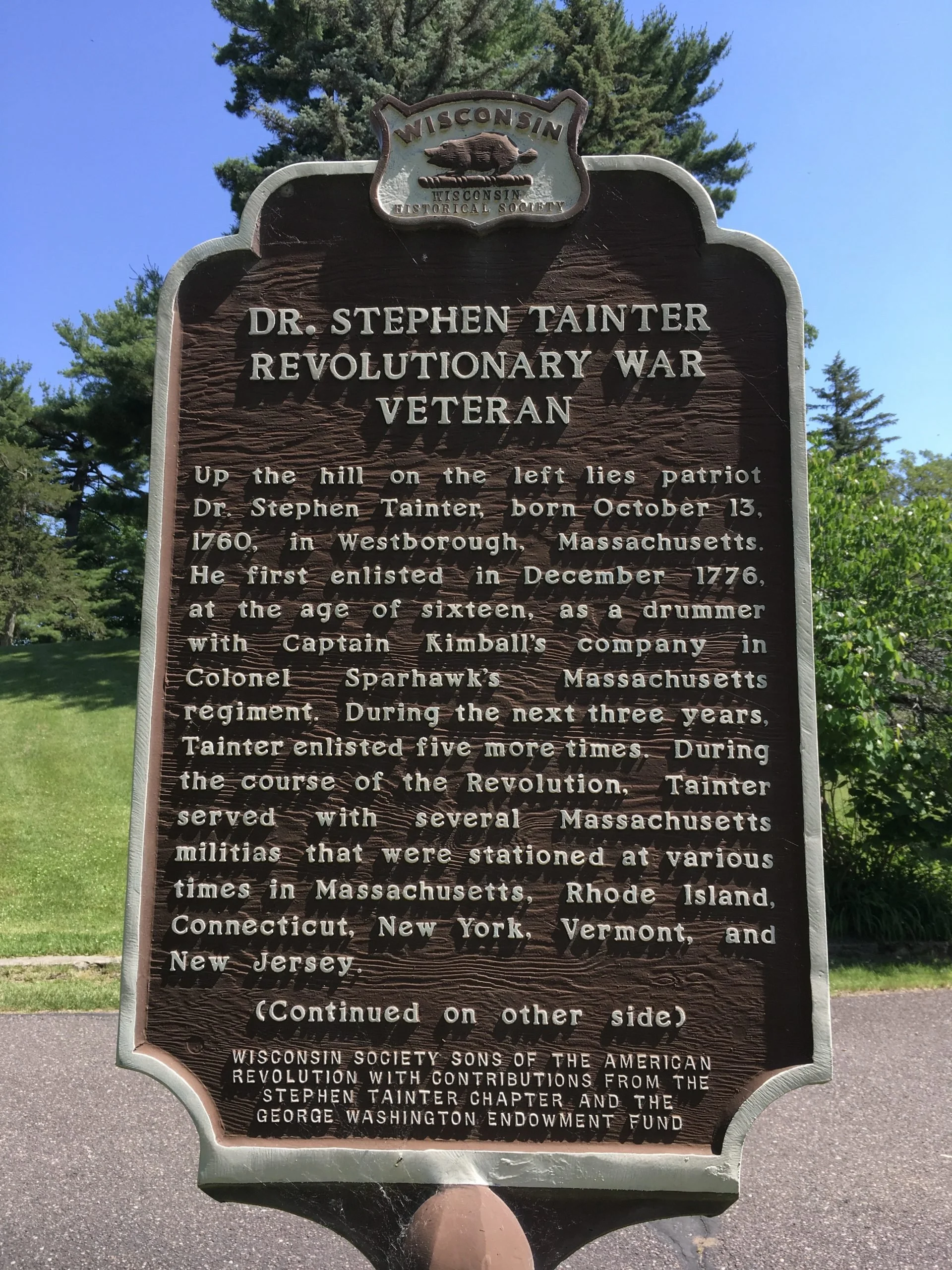
The Stephen Tainter Chapter was originally formed as the John B. Loyal Chapter in April of 1996. The first serving President was Mitchell Steinmetz of Eau Claire, and the first Secretary and Treasurer was Compatriot Joseph Phelps. In October of 2003 our chapter was renamed after Dr. Stephen Tainter Chapter, a Revolutionary War Patriot buried in Evergreen Cemetery, Menomonie, Wisconsin. The first President of the new chapter was Compatriot Donald Brill.
The Stephen Tainter Chapter covers twenty-eight counties reaching from Superior to the north, Hudson to the west, Jamestown to the south, and Eau Claire to the east—essentially the western half of the State of Wisconsin. Our members meet quarterly on the second Saturday of the month at the Metropolis Resort in Eau Claire, Wisconsin. We remain active in the community through various programs which promote patriotism and historical education of the Revolutionary War, the Declaration of Independence, the Constitution, the Bill of Rights, and the men and women who fought and sacrificed to achieve our countries independence from Great Britain.
Our Namesake
Dr. Stephen Tainter, Patriot
Stephen Tainter was born 13 October 1760 in Westborough, Massachusetts,[1] the son of Benjamin Tainter, of Newfane, Vermont, and Hannah Wood, his wife.[2] He married first on 18 December 1791 Elizabeth Gorham, who was born 20 December 1760, at Barnstable, Massachusetts, and died 3 October 1801, at Whitingham, Vermont. Children of his first marriage were Stephen G., Deacon Ezekiel W., Fordice and Elizabeth Tainter.[3] Stephen married second on 11 February 1802 Mercy Winslow,[4] who was born 11 April 1763, at Rochester, New York, and died 15 March 1822. Children of his second marriage were Clarissa K. W. and Adelia M. Tainter.[5]
Stephen Tainter began service in the Revolutionary War as a drummer boy at the age of 16. He re-enlisted several times, eventually ending his time in service during the war in 1782. After the signing of the Treaty of Paris on 3 September 1783, which officially ended the Revolutionary War, he served for a short period while stationed at Guilford, Vermont. His military service can be summarized as follows:
ca. 15 Dec. 1776–30 March 1777: enlisted as a drummer while a resident of Westborough, Massachusetts, in Capt. Kimball’s Company, Col. Sparhawk’s Regiment, Gen. Warner’s Brigade;
27 July–29 Aug. 1777: Capt. Timothy Brigham’s Company, Col. Job Cushing’s Regiment. Served as a drummer and was called out to assist at the battle of Bennington. His company arrived the day after the battle when British officer Gen. John Burgoyne surrendered;
27 Sep.–23 Oct. 1777: Capt. Joseph Warren’s Company, Lieut. Col. Wheelock’s Regiment. Served as a drummer with the “Northern Army”;
24 June–13 July 1778: Capt. Ephraim Lyon’s Company, Col. Wade’s Regiment. Served as drummer and was sent to Rhode Island;
20 July–31 Dec. 1778: Capt. Nathan Fisher’s Company, Col. Nathaniel Wade’s Regiment, Gen. Sullivan’s Army. Served as a musician and “was on the Island at the time of the Battle [of Rhode Island],” although he “was not in it.” Stephen Tainter, drummer, is also listed as serving in Capt. Ebenezer Belknap’s Company in Col. Wade’s Regiment for 1 month, 13 days, from 20 July to 2 September—the same time he was serving in Capt. Fisher’s Company;
12 May–ca. 6 July 1779: Capt. Joseph McNall’s Company, Lieut. Col. Samuel Price’s Regiment. Served as a private at Tiverton, Rhode Island;
1782: enlisted for five days in Capt. Josiah Fish’s Company of Foot, Colonel Stephen R. Bradley’s First Vermont Militia, General Fletcher’s Brigade;
30 Oct. 1783–1 March 1784: Capt. Benjamin Whitney’s Company stationed at Guilford, Windham County, Vermont. This was Stephen Tainter’s final service.[6]
After the war Stephen Tainter became a physician, and although moving frequently he resided mainly at Whittingham, Vermont, and Gainesville, New York—the latter where he practiced medicine for twenty-three years.[7] He was allowed a pension on his application which was executed 16 October 1832, while a resident of Wethersfield, Genesee County, New York.[8] In 1833, Dr. Tainter moved to Prairie du Chien, Wisconsin Territory, as he stated in a deposition, “for the purpose of enjoying in the decline of life the society of his son and being much afflicted with the rheumatism was in hopes to derive some benefit from the journey and change of climate.”[9] In 1846, the family moved to Utica, Crawford County, where Dr. Tainter died on 11 July 1847, at the age of 87. His remains were later moved by his grandson, Captain Andrew Tainter, to the Tainter family plot in Evergreen Cemetery in Menomonie. Capt. Tainter was reportedly a “lumber baron,” and the family name is prevalent in the community.[10]
Evergreen Cemetery occupies an entire island on the east side of Lake Menomin in the city of Menomonie. A Wisconsin Historical Marker located near the entrance gives directions to Dr. Tainter’s grave site, which is located in Lot 1, Section 4. Next to a large Tainter family grave marker is the Revolutionary War Patriot's bronze government marker, accompanied by a homemade wooden cross.
Sources:
[1] Worcester County, Massachusetts, “Records of Births, Marriages & Deaths, Town of Westboro, From 1717,” p. 25, Stephen Tainter, born 13 October 1760; digital image, “Massachusetts, Town and Vital Records, 1620–1988,” Ancestry (https://www.ancestry.com : accessed 15 January 2019). The birth record reads, “Stephen Tainter Son of Benj’a Tainter and Hannah his wife was Born october 13: 1760.”
[2] Charles M. Taintor, Genealogy and History of the Taintor Family, From the Period of Their Emigration From Wales, to the Present Time (Greenfield, Mass.: Merriam and Mirick, 1847), 22–23.
[3] Dean W. Tainter, History and Genealogy of the Descendants of Joseph Taynter, Who Sailed From England April, A.D. 1638, and Settled in Watertown, Mass. (Boston: David Clapp, 1859), 47.
[4] “Vermont Vital Records, 1760–1954,” digital images, FamilySearch (http://www.familysearch.org : accessed 29 September 2012), marriage record, Stephen Taintor to Mary Winslow, 11 February 1802; Family History Library microfilm 27,705.
[5] Dean W. Tainter, Descendants of Joseph Taynter, 47.
[6] Military services for Stephen Tainter were located in: Secretary of the Commonwealth, Massachusetts Soldiers and Sailors of the Revolutionary War, Vol. 15, Stibbens–Tozer (Boston: Wright & Potter Printing Co., 1907), 366 (Stephen Tainter), 382 (Stephen Tantor), 464 (Stephen Taynter), 465 (Stephen Tayntor); PDF images, Internet Archive (https://archive.org/details/massachusettssolstozmass : accessed 15 January 2019). Also, “Revolutionary War Pensions,” digital images, Fold3 (http://www.fold3.com : accessed 15 January 2019); Stephen Tainter (Pvt. & Drummer, Continental Army, Massachusetts Line), pension file S22006, pp. 8–11, 29; imaged from Revolutionary War Pension and Bounty-Land Warrant Application Files, M804 (Washington D.C.: National Archives, [no date]), roll 2337; Also, Wisconsin Society Sons of the American Revolution (WISSAR), Soldiers of the American Revolution Buried in Wisconsin (n.p.: WISSAR, 2011), 45.
[7] Dean W. Tainter, Descendants of Joseph Taynter, 47.
[8] “Revolutionary War Pensions,” Stephen Tainter (Pvt. & Drummer, Continental Army, Massachusetts Line), pension file S22006, p. 12, pension office letter, 29 April 1935.
[9] ibid., deposition, 6 September 1840.
[10] WISSAR, Soldiers Buried in Wisconsin, 45; Also, Dean W. Tainter, Descendants of Joseph Taynter, 47.